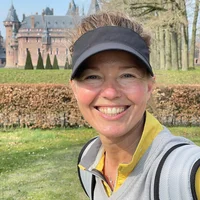
 By Marina Romanik
PGA-certified golf instructor
Updated
By Marina Romanik
PGA-certified golf instructor
Updated
What are the golden rules every new golfer must know?
Two ideas carry almost everything. First: play the ball as it lies. You do not move it, nudge it, or improve its spot before you hit. Second: every swing you make at the ball counts, even if you miss it completely. That air-swing has a real name, a “whiff”, and yes, it is one stroke. No do-over. I promise this feels less cruel once you laugh about it.
A few more you carry in your pocket. You may bring a maximum of 14 clubs; more than that is a two-stroke penalty per hole. And be on time. In a real competition, arriving more than five minutes late to your tee time means disqualification, and even one second late inside those five minutes costs two strokes. A tour player, Garrick Higgo, learned this the hard way at a big 2026 championship and started his round already two shots behind. On your relaxed Saturday round nobody disqualifies you, but the habit of being ready early is a gift to everyone you play with.
What happens when your ball is lost or goes out of bounds?
You get three minutes to search. If nobody finds the ball in that time, it is officially lost. Then you take what we call stroke-and-distance: add one penalty stroke and play again from where you hit the last shot. A ball out of bounds — marked by white stakes or white lines — is treated exactly the same way.
Here is the smart trick. If you think a ball might be lost or out of bounds, hit a provisional ball before you walk forward. You must say the word “provisional” out loud first. If you skip the announcement, that second ball becomes your ball in play immediately, and now you cannot use the first one even if you find it. Many Dutch clubs also switch on an optional local rule that lets you drop near where the ball was lost for two penalty strokes, to keep the round moving. It only counts when the club has activated it, so ask in the clubhouse.
What do the coloured stakes mean — red, yellow, and white?
Colours are your map. White means out of bounds — you have left the course. Yellow and red both mark penalty areas, usually water.
With yellow stakes you get two options, each for one penalty stroke: go back to where you played, or drop on a line straight back from the point where your ball crossed into the water. Red stakes give you all of that plus a third, friendlier choice: drop sideways, within two club-lengths of the crossing point, no nearer the hole. Red is the one you will meet most on holiday courses, and it is the kindest.
What can and can’t you do in a bunker?
The one rule to remember: do not touch the sand with your club before you swing. No grounding it behind the ball, no practice swing that brushes the sand, no testing how firm it is. That costs two strokes. Beginners feel this is unfair, and I understand.
The good news since 2019: you can remove leaves and twigs from the bunker now, and if your club touches the sand by accident while you take your stance, that is fine too. So relax your shoulders, pick a spot in the sand just behind the ball, and swing through. Sand play is more feel than fear.
When do you get free relief, and how do you take it?
Sometimes the course gives you a break with no penalty at all. Step in a rain puddle, land next to a sprinkler head, or find your ball in ground under repair, and you get free relief. These are “abnormal course conditions”. The rule asks one thing: the trouble must actually interfere with your lie, your stance, or your swing, not only sit in your line of sight.
To take it, find the nearest point where the interference is gone, no nearer the hole, and drop within one club-length. The dropping itself got simpler in 2023 — you drop from knee height, and the ball just needs to settle within that one club-length. An embedded ball, sitting in its own little crater from your shot, also earns free relief, as long as part of it is below the surface.
What are the rules beginners most often get wrong?
The invisible ones. New players often step right across another golfer’s putting line — the path between their ball and the hole — without knowing it is a real breach of courtesy. Nobody warns you before your first round, and then a kind partner quietly points it out. So walk around, not across.
Another surprise: the flagstick. Since 2019 you can putt with the flag left in the hole, and there is no penalty if your ball hits it. Leave it in, take it out, whatever helps you.
And do not feel silly for asking. One long-time rules writer shared that the USGA answers something like 20,000 rules questions a year, including a famous one about a ball bouncing off an alligator. Even players of forty years meet situations they have never seen. The rules always have an answer. You are allowed to look it up.
How do Dutch golfers learn the rules — and what is baanpermissie?
In the Netherlands there is a clear first step before you play freely: the NGF-golfbaanpermissie, your course access permit. An NGF-affiliated club gives it to you after some beginner lessons and a free theory evening about safety, pace of play, and caring for the course. Once you hold it, you may play on roughly 110 Dutch courses that accept it, not only the club that issued it. You also receive a GSN number, a digital NGF card, and the GOLF.NL app, and since July 2024 you can even take the rules exam through that app from your sofa.
After that comes your first real handicap. The old GVB is gone; today the Netherlands uses Handicap 54 under the World Handicap System. To earn it you score 36 or more Stableford points over 18 holes, or 19 or more over 9 holes, with an official marker beside you. The usual path is the Golfstart programme: six group lessons, loaner clubs, free range balls, then your exam and permit. Both my home clubs, Chi Chi Golf in Utrecht and Golfschool Hoenderdaal in Driebergen, run exactly this pathway — and I teach it there myself.
A beginner once described their first time on a par-3 course after the range: wonderful fun, but every short hole felt harder than expected. That gap between the range and the real course is normal. Uneven ground, real distances, a little pressure. It is also where golf becomes golf.
Want the full detail? Every one of the 25 Rules is explained, one by one, in my rule-by-rule Rules of Golf guide — handy for settling a friendly “which rule is that?” on the course. If the rules still feel like a lot, that is completely okay — they click fast once someone shows you on the grass. That is what our beginner golf etiquette guide is for, and how to keep a good pace and what to wear so you feel at home from the first tee. When you are ready to know what a round costs, read about green fees . And if you would like me to teach you the rules the easy way, on the course, come and take a lesson with me. I would love to see you play.
From reading to playing
Want help putting this into practice?
I'm Marina Romanik, PGA golf instructor. I give friendly golf lessons in Utrecht at Chi Chi Golf and Golfschool Hoenderdaal — for beginners, kids and advanced players, in English, Dutch, Ukrainian and Russian. Your first lesson is €25.
Keep learning
See all →Golf etiquette, made simple
A few friendly habits are all you need to feel completely at home on any golf course.
Read guide →Golf dress code in the Netherlands — what to wear
Wondering what to wear to a Dutch golf course? Here is the short answer: a collared polo shirt, proper trousers or bermuda shorts, and golf shoes with soft spikes. That combination is welcome almost everywhere in the Netherlands. But there is a nice surprise too — the rules are more relaxed than many beginners fear, and at some places, like where I teach, there is barely a dress code at all.
Read guide →Pace of play: how not to hold up the group
Play "ready golf": when you are ready and it is safe, you hit — you do not wait for the person who is officially "away". Keep up with the group in front, not just ahead of the group behind. That is the whole secret. Everything else on this page is just small habits that make it easy.
Read guide →